
BESS Municipality of Shuniah
LINKS
ON – 167 Mount Baldy Rd 1 & 2 Battery Energy Storage System (BESS) Projects
Project Details
- Project Names: ON – 167 Mount Baldy Rd 1 & 2
- Project Type: Lithium Iron Phosphate Battery Energy Storage System (LFP BESS)
- Capacity: 200 MW / 1,600 MWh each (400 MW / 3,200 MWh total)
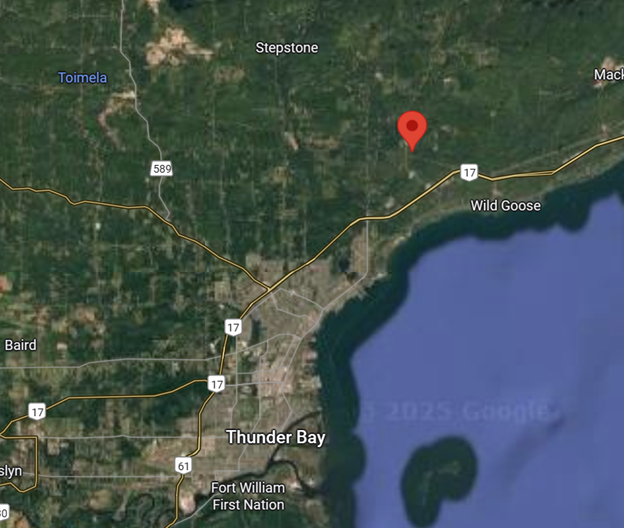
- Location: Municipality of Shuniah, Ontario, GPS: 515086, -89.150612 (see site plan below for location / layout)
- Proponent: SUNN LT23 Corp
- Target in-service date: May 1, 2030
Program Background
After more than a decade of strong supply, Ontario's electricity sector today is seeing growing demand, an evolving supply mix and a drive toward grid decarbonization. Combined, these factors are spurring the IESO's ongoing large-scale resource acquisition effort to ensure sufficient supply will be available into the 2030s and beyond.
To address these needs, Ontario's Independent Electricity System Operator (IESO) is competitively procuring 1.6 gigawatts of capacity through the LT2 RFP(c-1). This procurement will help ensure that Ontario has the electricity it needs to support communities, businesses, and industries into the 2030s and beyond, while also advancing the province's decarbonization and reliability goals.
About the Project
The ON – 167 Mount Baldy Rd 1 & 2 Battery Energy Storage Projects are proposed battery energy storage systems (BESS) to be located at Mount Baldy Rd in the Municipality of Shuniah, Ontario. Developed by SUNN LT23 Corp, a subsidiary of Powerbank Corp, these projects will be proposed to Ontario's Independent Electricity System Operator (IESO) Long-Term 2 (LT2) procurement.
The two projects proposed consist of 200 MW / 1,600 MWh Lithium Iron Phosphate (LFP) battery systems connected directly to Ontario's electricity grid (HONI Transmission Lines). The facilities will store electricity from the grid during periods of low demand — typically overnight — and discharge it back into the grid during peak demand, strengthening grid reliability and helping meet Ontario's growing electricity needs. Together, they are expected to occupy roughly 23.94 acres of land and include all necessary components such as containerized battery units, inverters, HVAC, and fire suppression systems.
Site Location in Shuniah
Preliminary Site Plan
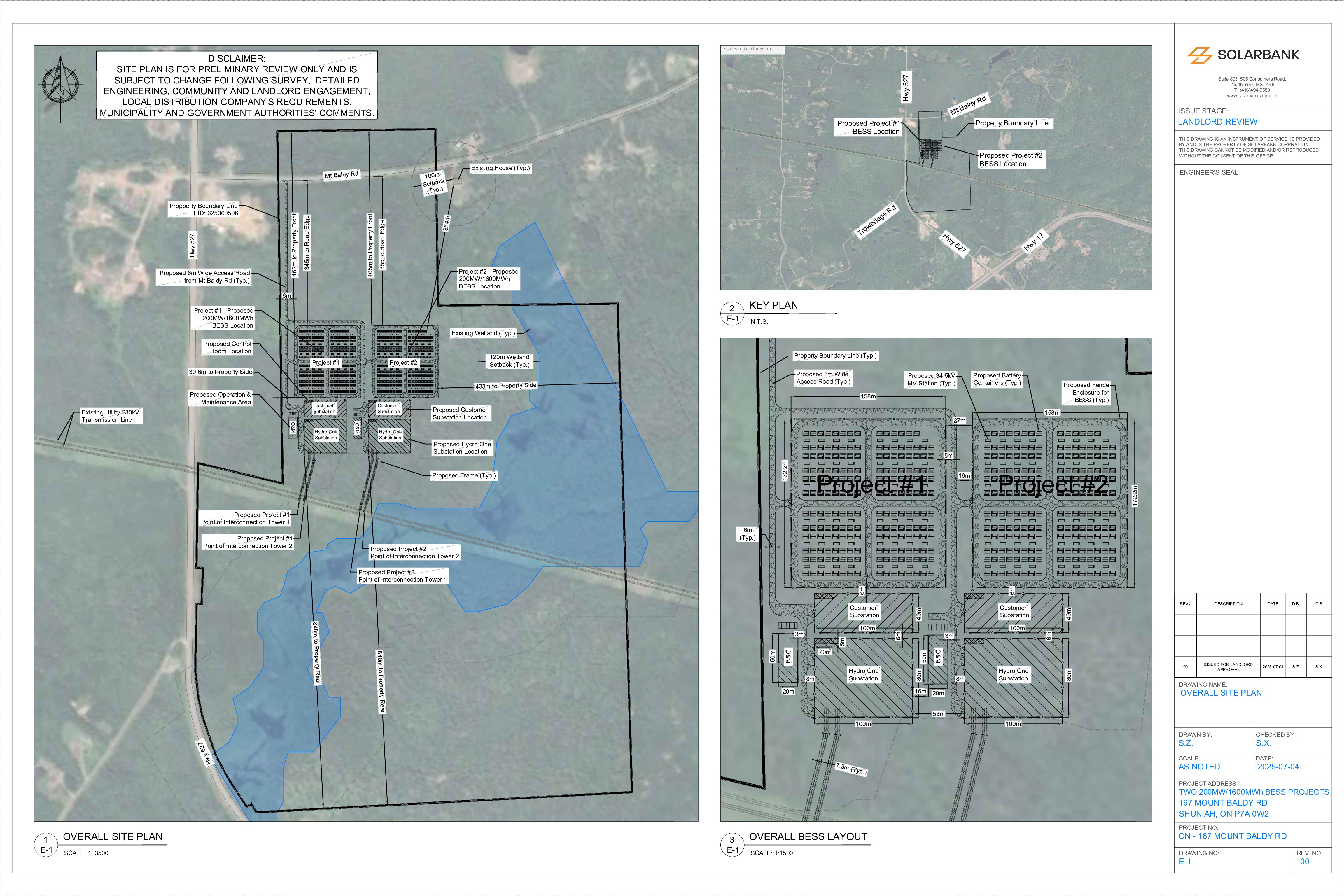
*please note, site plan is preliminary and subject to change pending community engagement, permitting, engineering studies, etc.
Current Stage and Municipal Support
Our two BESS projects are currently in the proposal stage. We are preparing an application to submit to the LT2 RFP. We are conducting community engagement, assembling the submission materials, and requesting a Municipal Support Resolution (MSR) from Council. If awarded an MSR, we would finalize the LT2 application submission. Please note that neither the MSR nor our application guarantees a contract award. If we are selected for a contract, we would then proceed with detailed permitting and development work; only after meeting all regulatory requirements (Municipal, MECP, ESA, etc.) would we finalize engineering and move into procurement and construction.
Post-award approvals (including but not limited to):
- Municipal approvals: Official Plan and Zoning By-law review or amendment, Site Plan Approval, and Building Permit.
- Provincial approvals: Environmental Compliance Approvals (MECP) for stormwater or sewage works, and coordination with other provincial bodies (e.g., conservation authorities, heritage or natural feature reviews) as applicable.
- Electrical Safety Authority (ESA) approvals: Plan review, electrical permits, inspections, and connection authorization under the Ontario Electrical Safety Code (OESC).
Specific requirements may vary by municipality and site. All applicable processes will be followed, and the public will be updated as key milestones are reached.
Developer Information and Procurement Participation
The project owner, SUNN LT23 Corp., is a subsidiary of PowerBank Corp., a public company based in Toronto, ON, and is a renewable and clean energy project developer and asset operator. Since 2013, PowerBank has advanced the growth of renewable and clean energy projects, helping to reduce carbon emissions through its development, engineering, and asset management services across Canada and the United States.
We are currently preparing applications for the IESO's Long-Term 2 (LT2) RFP (C-1), which are due on December 18, 2025. If selected for a contract, permitting and development activities would begin in late 2026, following all applicable protocols related to safety, environmental protection, wetland conservation, and visual screening. Construction is anticipated to begin in 2027 at the earliest, with commercial operation expected by 2030. The project will operate for 20 years under the LT2 contract.
Environmental and Community Impact
Community
Community engagement includes an open house held on September 22, 2025, at 6:30 p.m. at the McGregor Recreation Centre (800 Lakeshore Dr, Shuniah, ON). This meeting provided community members with an opportunity to learn about the project and ask questions directly to the project team. Ongoing communication will continue throughout development and operation. A Community Benefits Agreement, to be entered into with the Municipality of Shuniah, will guide how the project supports local priorities and ensures that the surrounding area benefits directly from the investment over its lifetime.
Economy
The projects will support local economic growth by creating employment opportunities during the construction phase — including jobs for construction workers, electricians, and other skilled trades. Over the long term, operations and maintenance activities will provide stable technical positions and ongoing employment. The projects will also generate municipal tax revenue that contributes to essential public services and infrastructure improvements.
Environment
By storing clean energy and releasing it when needed, the projects will help optimize Ontario's electricity grid using proven, safe technology. This supports the province's climate goals, reduces reliance on fossil fuels, and lowers greenhouse gas emissions — all while maintaining a minimal environmental footprint.
Technology and How It Works
BESS plays a crucial role in storing excess electricity, making it available during peak demand or supply disruptions. This reduces reliance on costly and environmentally harmful peaking plants. Through this approach, BESS helps stabilize the grid, ensuring that Ontario's energy system can meet both growing and peak demand using cost-effective and environmentally friendly solutions. The project contributes to the creation of a flexible and resilient power grid that aligns with the government's long-term energy goals, while also minimizing environmental impact and maintaining affordability for consumers.
Fire Safety and Protection
Safety is built into both the equipment and the overall project design from the start.
- The system is remotely monitored 24/7/365. It can be remotely shut off.
- All equipment meets strict safety certifications and follows national safety standards, such as NFPA 855, UL 9540 and 9540A.
- Before construction begins, we will work closely with local fire departments to plan safe access, training, and prepare a full emergency response plan.
Expected Timeline
December 2025: Application Submission
The project team will prepare and submit the full proposal to the IESO as part of the Long-Term 2 (LT2) procurement. This is the first key milestone and marks the official entry into the selection process for grid-connected battery storage projects in Ontario.
Fall 2026: Development Phase Begins
With contracts in place, the project moves into detailed engineering, permitting, procurement, and construction mobilization. This phase covers site preparation, equipment manufacturing, and early construction activities.
2029 – 2030: Commercial Operation Date (COD)
The BESS is expected to reach full commercial operation within this window. Once operational, the system will begin providing grid services such as peak load management, renewable energy integration, and improved grid reliability.
Resources and Downloads
QUESTIONS AND CONTACTS:
Please feel free to reach out to the contact below if you have any questions regarding the procurement process, companies involved, and/or proposed projects.
BESS FAQS
All you need to know
Battery storage plays a critical role in keeping Ontario's power system stable and reliable. It stores clean energy when demand is low and releases it when demand is high, helping prevent blackouts and grid stress. It also supports renewable energy by storing power when the sun isn't shining or the wind isn't blowing, ensuring consistent electricity supply even when natural conditions change.
By clicking 'Accept All Cookies', you agree to the storing of cookies on your device to enhance site navigation, analyze site usage, and assist in our marketing efforts. See our Privacy Policy for details.